• Your lease includes service by BOXX Modular and its authorized subcontractors for repairs and maintenance of the building and equipment resulting from routine wear
    • This does NOT include HVAC filters and light bulbs.

  • Your lease does not include charges for any service performed by other vendors or individuals without prior, written approval from BOXX Modular.

  • Your lease does not include janitorial services, service charges to repair damages or failures caused by improper or inadequate electrical service, theft and vandalism, physical damage caused by accidents, negligence, extreme weather, and/or Acts of God.

  • The customer is responsible for the re-leveling and/or necessary adjustments to the building and doors that may be needed due to settlement of the site's ground surface.

  • BOXX Modular is not responsible for frozen water in piping. 
  • You must receive written authorization from BOXX Modular before making:
    • Repairs (in order to be reimbursed for any work that is done to the building).
    • Modifications to the building.

  • Relocation of any BOXX building must be pre-approved by BOXX Modular.

General cleaning is important when it comes to maintaining proper functionality of your building(s), as well as preventing build-up and related damages. We suggest regular, general cleaning for:

  • Kitchen areas, appliances, and fixtures.

  • Bathrooms, including toilets and sinks.
    • PRO TIP: Never flush anything down a toilet that isn't toilet paper to avoid clogging and plumbing issues.

  • All surfaces and floors.
    • PRO TIP: With swivel chairs, we recommend using floor savers. We have floor saver options for rent. Please contact your local sales representative to discuss. 
    • As an alternative, swivel chairs with rubber wheels are also a good option.

To maintain the exterior of and area around your unit, it is important to:

  • Inspect and clear any surrounding debris and/or clutter (such as tools, equipment, twigs, leaves, etc.).

  • Inspect and clear any ice and snow (when applicable).

  • For all mobile units: Inspect all tires and ensure they are properly inflated.

The BARD HVAC filter system equipped to your unit(s) takes care of both heating and cooling.

BARD HVAC filter systems require routine inspection and servicing every 30 days (minimum) to ensure functionality and mitigate costly repairs. This includes:

  • Routine filter changes (in extreme and/or dusty conditions, please change filter more frequently as needed)
  • Routine coil cleaning

In the event that you hear any unusual noises (ex. rattling) or smell anything unusual (ex. burning) coming from a BARD unit, please report to your local service team immediately. 


Instructions For Changing Filter:
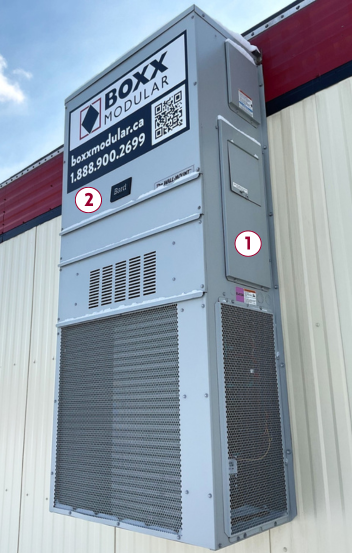
  1. Prior to changing the filter, always ensure:
    • The BARD system's internal breaker is switched off (internal breaker location marked on image). 
    • All HVAC/BARD system breakers in the electrical panel are switched off
    • If Applicable: The safety breaker/disconnect switch has been switched off (located adjacent to the BARD system). Please note that not all units have this switch.

  2. Remove the center service door by removing the 4 screws (center service door marked on image).

  3. Slide out old filter.

  4. Slide in new filter with the arrow facing up. Put center service door back onusing screws.
    • PRO TIP: It's good practice to write the date on the filter when replacing it so you can keep track of when it was changed last.

  5. Switch all breakers switched off in step 1 back on.

Please ensure you are cleaning the filter at least once every 30 days. If conditions are excessively dusty, please clean more often as required.


Instructions for Cleaning Filter:

  1. The filter can be removed from behind the front grill of the unit.

  2. Once the filter is removed, wash with warm water and let dry completely OR vacuum the filter.

  3. Although the filter is reusable, there will come a time when it needs to be replaced. If the filter is too worn down to filter properly, please replace with a new one.

  • Regular vacuuming and/or blowing accumulated dust out of the furnace is recommend.

  • Use Command hooks whenever possible on drywall, doors, and FRP.

  • Use corkboards rather than pinning notes/material directly onto the drywall. 

  • If anything must be screwed into the wall, put the screws through the batten strips. This makes for a much easier, cheaper repair.

  • We recommend having floor savers if using swivel chairs. As an alternative, swivel chairs with rubber wheels are also a good option.  
  • Please note that any additional circuits added by the client will be removed at their cost

  • Ensure there is water supplied to your unit(s) before powering up the pump(s), as running them dry will cause serious damage

  • The hot water heater must be filled with water, with all air evacuated from the system, before turning on the water heater electrical breaker.
    • If you fail to do so, you may damage the water heater element.

  • Ensure waste water is being dealt with correctly (i.e. into a tank, internal or external, or into a sewage system). 
    • Care must be taken to prevent pump damage from running dry.

  • Ensure nothing inappropriate is flushed down toilets and sinks, either deliberately or accidentally. Paper towels, rags, mop string, feminine hygiene products, etc. can plug a sewage pump, causing down time and costly repair charges.

  • If you plan on disconnecting the power and/or leaving units unheated for any period of time, you must ensure your systems are properly winterized.

  • If signs or brackets must be screwed to the exterior of a unit, try to use the existing siding screws.

  • Adding gutters and/or canopies (that are not part of a BOXX Modular add-on package) is a client cost
    • Please be mindful to correctly install to avoid potential damage(s) to the roof (which may cause further damage over time).
    • All gutters and canopies must be removed prior to transport.

  1. Sweep and/or vacuum floor(s).

  2. Remove all data, communication, and fire alarm fixtures and wiring.

  3. Remove any furniture and equipment that is not owned by BOXX Modular.

  4. Remove all obstructions such as construction debris, skirting, tie downs, custom stairs, ramps, fences, landscaping, plumbing, piping, and any other equipment not leased from BOXX Modular (unless otherwise stated in contract details).

  5. Remove all personal belongings.

  6. Ensure the building(s) being returned are accessible by truck. This includes:
    • Access to and area around the unit is clear.
    • Access to the unit is not through an area that has soft ground, large amounts of mud, or excessively wet grass.

  7. Stands and staircases are visible and not sunken into grass or mud.

  8. Disconnect hydro and plumbing.

  9. Winterize, drain, and evacuate the unit of water, regardless of the season.
  10. Ensure each key is left in the appropriate door OR left inside with the exterior doors unlocked.
    • If no key is available, locks will need to be replaced and a charge will be incurred.

  11. Ensure all windows are closed and all blinds are raised.

  12. If applicable: Remove the chimney extension prior to loading, and the roof chimney must be covered to prevent damage from exposure.

  13. If applicable: Remove hydro-mast. 

PLEASE NOTE:

  • If there is a wait time associated with preparing a site for removal transport, a charge may be incurred for the delay.
  • An additional cleaning fee may be charged if returned building(s) require excess clean-up. We kindly ask that all building(s) are returned in the same condition that they were received (accounting for normal wear).

  • Before switching to A/C, change the BARD HVAC system filter and clean the coils.
    • It's important to note that filter changes and coil cleaning should be done regularlyFor more information on general BARD system maintenance, please reference the HVAC System Housekeeping section under the Regular Maintenance category.

  • Do your best to retain cool air. Please keep windows and doors closed and ensure your thermostat is set at a cool, stable temperature at all times.
    • We recommend setting between 21°C and 24°C (~70°F and 74°F) in warmer months. If the temperature is set any lower, your system may freeze up.

  • If hooking up to a power generator, please:
    • Speak with an electrician to ensure the proper power requirements are met according to the size of your unit(s). 
    • Pay close attention to generator fuel levels at all times, ensuring that it never runs out. 
    • Note that we do not recommend the use of power generators due to 1) voltage spikes and 2) their potential to cause costly damage to BARD systems if left running with no fuel.
  • If you are experiencing trouble switching the thermostat from heating to cooling, please call your local BOXX Modular service teamOur service teams can walk you through the process by providing guidance and direction over the phone.

HAVE A MAINTENANCE CONCERN ABOUT YOUR BARD HVAC SYSTEM FOR COOLING? For troubleshooting instructions to common concerns, please reference the Air Conditioning section under the Troubleshooting category.


Some of our units have Through Wall A/C units. If your building has a Through Wall A/C unit:

  • Please avoid plugging anything into the outlet supplying power to the unit, as this will likely trip the circuit breaker.

HAVE A MAINTENANCE CONCERN ABOUT YOUR THROUGH WALL A/C UNIT? For troubleshooting instructions to common concerns, please reference the Air Conditioning (Under Common Concerns: Through Wall A/C) section under the Troubleshooting category.

It is important to note that clients are responsible for re-leveling and/or necessary adjustments to their building(s) and door(s) that may be needed due to settlement of the site's ground surface. For more information on client responsibilities, please reference the Necessary Approvals and Client Responsibilities section under the Maintenance Requirements category.

If your building is no longer sitting level to the ground, you can:

  • Before switching to heating, change the BARD HVAC system filter and clean the coils.
    • It's important to note that filter changes and coil cleaning should be done regularlyFor more information on general BARD system maintenance, please reference the HVAC System Housekeeping section under the Regular Maintenance category.

  • Do your best to retain heat. Please keep windows and doors closed and ensure your thermostat is set at a warm, stable temperature at all times.

  • If hooking up to a power generator, please:
    • Speak with an electrician to ensure the proper power requirements are met according to the size of your unit(s). 
    • Pay close attention to generator fuel levels at all times, ensuring that it never runs out. 
    • Note that we do not recommend the use of power generators due to 1) voltage spikes and 2) their potential to cause costly damage to BARD systems if left running with no fuel.

  • If you are experiencing trouble switching the thermostat from cooling to heating, please call your local BOXX Modular service teamOur service teams can walk you through the process by providing guidance and direction over the phone.

HAVE A MAINTENANCE CONCERN ABOUT YOUR BARD HVAC SYSTEM FOR HEATING? For troubleshooting instructions to common concerns, please reference the Heating section under the Troubleshooting category.

A shut-down applies to any period of time where power will be disconnected, i.e. heat will be shut off, even if it's just a few days.

It is important to either 1) ensure heat is left on, or 2) that units are properly winterized (when disconnecting the power and/or leaving units unheated) to prevent damage.

If units are left unheated and are not properly winterized, waterlines will freeze and pipes will likely burst. Once defrosted, leaks, plumbing damage, and water damage are very likely, and in most cases, very costly.

If you choose to leave the power on during shutdown periods (recommended), it's important to ensure:

  • You maintain an average temperature of ~16 degrees C inside units at all times
  • If on a power generator
    • Ensure gas is full (running out of gas while running WILL damage the BARD unit). 
    • An electrician has assured proper power requirements are met according to the size of your unit(s).

For Water Tanks with Pump Assemblies:

Tanks need to be emptied, pumps drained via the drain plug, and waterlines blown out. Ensure the waste and water tanks as well as the vent system (toilet tanks, bowls, urinals, and traps) are emptied before they are unplugged, with environmentally-friendly antifreeze added to the pump priming port(s) afterwards.

To Avoid Any Issues, Ensure Your:

  • Plumbing/water lines are blown out or filled with antifreeze prior to shutdown.
  • Fixtures and p-traps have antifreeze added.
  • Urinal water lines (vertical drops to flush valve) need to be blown out and/or have antifreeze added.

Downloadable Guide:

Plumbing Winterization Checklist

IMPORTANT REMINDER:

NEVER disconnect heat (electricity) from the unit(s) until plumbing fixtures and lines have been drained and properly evacuated of all water. If this is not done, the pipes will freeze and burst. Charges will be applied if unit is not adequately drained.

If your unit(s) is equipped with any of the following:

  • Holding tanks with or without pumps
  • Hot water tanks
  • Washrooms with porcelain fixtures
  • Surface mounted plumbing and in-wall/in-floor plumbing and fixtures

AND you plan on disconnecting the power and leaving units unheated for any period of time, even if it's just a few days. This applies to all units with plumbing, such as portable washroom units and buildings with kitchens.

Please Note:

  • In areas where weather is consistently cold and/or temperatures are unpredictable, winterization is recommended year round.
  • Winterization is required prior to transport, regardless of the season.
  • If units are left unheated, are not properly winterized, and damage is incurred as a result, the necessary repairs are a client expense.

At extremely low temperatures, the below are common issues and building/system failure points to watch for. We highly recommend inspecting all to ensure proper functioning in advance of a forecasted cold snap.

  • Heat Tracing Systems: Freezing due to systems not being properly energized (i.e. not plugged in, tripped breaker, etc.).
    • Ensure your heat tracing system is energized at all times.

  • Exterior Wall Plumbing / Fire Sprinkler Lines: Issues with/related to lines freezing. 
    • Ensure all systems are properly winterized (when required). 
    • Identify and monitor freeze-prone areas (such as rooms with plumbing on exterior walls, unheated mechanical chases, ceiling spaces, garages, and vacant wings).

  • RTU (rooftop unit) Heating Components (igniters, flame sensors, gas valves)Building heater not functioning properly.  
    • Inspect RTUs: Check that belts, filters, burners, and ignition systems are all in tact/functioning properly.

  • Air Dampers: Commonly stick open in extreme cold and flood buildings with outside air.
    • Ensure dampers are operating correctly.

  • Cold Rooms: If a cold room doesn't seal properly, the cold air can lower the temperature in adjacent areas. 
    • Ensure cold room seals are intact, and that doors are always shut completely when going in and out.

  • Battery Systems (security/alarm panels, access control): It's common for battery performance to drop sharply in extreme cold.
    • Inspect UPS units and battery backup systems. 

  • Vehicles/Equipment: If vehicle/equipment is using untreated fuel, this can prevent engines from starting/running in cold weather. 
    • Move fleet vehicles indoors or utilize engine block heaters.

We highly recommend going through the Proactive Checklist for Extreme Cold (–40°C/F) section (found below) for further information.

  1. Ensure all windows and exterior facing doors are fully closed and latched (especially loading bays, stairwells, and mechanical rooms). 

  2. Maintain an indoor temperature above a minimum threshold (often 15–18°C/59–65°F in unoccupied buildings; some insurers require minimum 13°C/55°F). Increase the setpoint in vulnerable areas such as perimeter zones, attics, crawlspaces, and near pipes).

  3. Disable scheduled temperature setbacks (common in offices and schools).

  4. Ensure heating systems are functioning prior to shut-down periods (i.e. weekends). Check for alarms, unusual noises, error codes, and temperature anomalies.

  1. Identify and monitor freeze-prone areas (such as rooms with plumbing on exterior walls, unheated mechanical chases, ceiling spaces, garages, and vacant wings).
    • NOTE: This is a common failure point. Please reference What to Watch for: Common Failure Points at –40°C/F located directly above this section.

  2. Ensure all heat tracing is energized.
    • NOTE: This is a common failure point. Please reference What to Watch for: Common Failure Points at –40°C/F located directly above this section.

  3. Confirm all insulation on exposed piping is intact. Repair missed and/or damaged sections as required.

  4. Keep cabinet doors open that are located under sinks on exterior walls. This allows for warm air circulation.

  5. Ensure all systems are properly winterized(when required). 
  6. When applicable: Allow a slow drip from faucets in high-risk areas.

  1. Inspect rooftop units (RTUs) before the cold snap hits. Check that belts, filters, burners, and ignition systems are all in tact/functioning properly.
    • NOTE: This is a common failure point. Please reference What to Watch for: Common Failure Points at –40°C/F located directly above this section.

  2. Ensure that combustion air intakes, exhaust vents, and chimney caps are clear (snow and ice can choke them).

  3. Ensure that make-up air units and ERVs are not introducing excessive cold air. If needed, adjust the settings.

  4. Ensure dampers are operating correctly (they often stick open in extreme cold and flood buildings with outside air).
    • NOTE: This is a common failure point. Please reference What to Watch for: Common Failure Points at –40°C/F located directly above this section.

  1. Before the cold snap hits, test emergency generators and ensure fuel levels are sufficient.

  2. Inspect UPS units and battery backup systems. It's common for battery performance to drop sharply in extreme cold.
    • NOTE: This is a common failure point. Please reference What to Watch for: Common Failure Points at –40°C/F located directly above this section.

  1. Inspect sprinkler rooms to ensure they remain heated above 40°F/4°C minimum (NFPA recommendation).

  2. Check the dry pipe, pre-action, and deluge systems to ensure:
    • Air compressors are working properly.
    • Low-air alarms are functioning properly.
    • Valve rooms are sealed and heated.

  3. Ensure anti-freeze loops have proper concentration.

  1. Ensure roof drains and scuppers are clear (ice buildup can cause roof failure).

  2. Check for heat loss paths that can cause ice dams. Note that snow melt on the roof during extreme cold often signals a problem.

  3. Ensure exterior lighting and cameras are functioning properly, noting that the cold can sometimes kill power supplies.

  4. If applicable: If vehicle(s)/equipment are using untreated fuel, this can prevent engines from starting/running in cold weather. Move fleet vehicles indoors or utilize engine block heaters to avoid this issue.
    • NOTE: This is a common failure point. Please reference What to Watch for: Common Failure Points at –40°C/F located directly above this section.

  • Is the unit properly hooked up to 120/240 volts with the proper sized wire?

  • Double check that all breakers are on, including the main breaker (certain types of breakers appear to be on but may not be tripped completely. Switch fully off and then on again).

If the issue persists, please contact us for assistance.

  • Double check that all breakers are on, including the main breaker (certain types of breakers appear to be on but may not be tripped completely. Flip breakers off and on again).

  • Double check that all switches are on. If bulbs are burned out, replace. 
    • Please note that replacing bulbs is a client responsibility. 

If bulbs are in good condition and still don't work, please contact us for assistance.

  • It's highly likely that the light ballasts are cold. Flickering usually stops after a few minutes as they warm up. 

If flickering persists, please contact us for assistance.

  • In the flickering light fixture, replace one bulb at a time.

If flickering persists, please contact us for assistance.

  • Try changing the bulb(s).

If the issue persists, please contact us for assistance.

  • Check the GFCI receptaclein the bathroom (when applicable).
    • If tripped, reset.

  • Double check that all related breakers are on.

If there is still no power, please contact us for assistance.

  • Check to see if there are too many cords plugged into the same receptaclethat could be causing an overload in the circuit.
    • Please Note: If a circuit is overloaded, the breaker is designed to trip. It's important to be aware of the amount of power being used per circuit to prevent trips. 
      • High-draw items like space heaters, fridges, microwaves and some office equipment can trip breakers easily, and may need their own circuit.
      • It's good practice to add-up the wattage consumption of the devices plugged into each receptacle and ensure it does not exceed what the breaker is designed to handle.
      • Service calls resulting from a circuit overload may be billable.

If the issue persists, please contact us for assistance.

  • Check your toilet(s): if the water has evaporated, sewer gas can enter the interior. Open the door to air out the unit(s), then simply flush the toilets to refill bowls with water.
    • Note that this may apply to sinks if p-traps are dry, or if the vacuum truck that empties the sewage has too much power.
    • This occurs most commonly on sites where the women's side is not used, or if a cubicle is being used for storage.

If the smell persists, please contact us for assistance.

  • Check to ensure the water tank is full.

  • Check the circuit breaker to see if the pump is receiving power.

If the issue persists, please contact us for assistance.

  • It's very likely that the flush valves require adjusting, as they can shift during transport.

If the issue persists, please contact us for assistance.

  • It's very likely that the toilet has shifted, and/or the unit is not level. Please adjust.

If the issue persists, please contact us for assistance.

  • It is likely that your unit(s) were not properly winterized, and/or left without power in freezing temperatures. 
    • In cold weather, it is important to either 1) keep inside temperatures above freezing by ensuring heat is left on, or 2) that your unit(s) are properly winterized (when disconnecting the power or leaving units unheated) to prevent damage.
    • If units are left unheated and are not properly winterized, waterlines will freeze. Once defrosted, leaks, plumbing damage, and water damage are very likely, and in most cases, very costly. 

  • For winterization information, please reference the Shut Down Periods and Winterization section under the Seasonal Maintenance category.

If repairs are required or this was not the case, please contact us for assistance.

  • For tank type heaters: Check the on/off switch and breaker in either the electrical panel and/or by the hot water heater.

  • For on demand heaters: First, check all associated breakers. 
    • Do not replace the sink aerator with a higher flow volume, as this will cause the heater to malfunction and reduce your hot water temperature.

If the issue persists, please contact us for assistance.

  • First, check the building's thermostat:
    • Is the thermostat set to a reasonable temperature? If the temperature is set too low, the system may freeze up. We recommend a setting between 21°C and 24°C (~70°F and 74°F) in warmer months for this reason.
    • Ensure the thermostat is set to the appropriate setting (i.e. heat vs. cool).
    • Ensure the area around the thermostat is free of obstructions, as items blocking the thermostat can cause the built-in temperature sensor to not work correctly.
    • Double check that the batteries are charged. If not, remove the old batteries and let the thermostat reset for several minutes before replacing.
    • If using a Programmable Thermostat: Follow the program sequence on the thermostat. Instructions can usually be found under the cover. 

  • If the unit was very hot when the A/C was first turned on, please remember that it may take some time for it to cool down the room.

  • If the door to the unit(s) is opened continuously, it can cause the air to warm up faster than an A/C system can cool the air.
    • Try to slow traffic in and out of the unit until cooling is complete.

  • Ensure the external BARD system has at least a 3 foot clearance from any/all surrounding objects.

  • Ensure the unit(s) is properly hooked up to 120/240 volts with the proper size wire.

  • Ensure that the air flow within your building is not restricted:
    • Confirm that there is enough clearance around the internal ventilation.
    • Confirm that the filter is being replaced on a regular schedule. If not, please replace. If the old filter is excessively dusty, this can restrict the air flow.

  • Ensure the A/C breaker(s) in the electrical panel box are on. 

  • Ensure the BARD system's internal breaker is on (located behind the access panel on the right side of the BARD system). 

  • If applicable: Check that the safety breaker/disconnect is on (located adjacent to the BARD system). Please note that not all units have this switch.

If the issue persists, please contact us for assistance.

  • Ensure that the air flow within your building(s) isn't restricted:
    • Confirm that there is enough clearance around the internal ventilation.
    • Confirm that the filter is being replaced on a regular schedule. If not, please replace. If the old filter is excessively dusty, this can restrict the air flow.

  • Check that the air diffusers are fully open.

  • If applicable: Ensure the return air (the grill on the inside wall, adjacent the external BARD system) is on and not covered. 

If the issue persists, please contact us for assistance.

Instructions For Changing Filter:

  1. Prior to changing the filter, always ensure:
    • The BARD system's internal breaker is switched off (internal breaker location marked on image). 
    • All HVAC/BARD system breakers in the electrical panel are switched off
    • If Applicable: The safety breaker/disconnect switch has been switched off (located adjacent to the BARD system). Please note that not all units have this switch.

  2. Remove the center service door by removing the 4 screws (center service door marked on image).

  3. Slide out old filter.

  4. Slide in new filter with the arrow facing up. Put center service door back onusing screws.
    • PRO TIP: It's good practice to write the date on the filter when replacing it so you can keep track of when it was changed last.

  5. Switch all breakers switched off in step 1 back on.


If you have any questions or require further instruction, please contact us for assistance.

  • If the unit was very hot when the A/C was first turned on, please remember that it may take some time for it to cool down the room.

  • If the door to the unit(s) is opened continuously, it can cause the air to warm up faster than an A/C system can cool the air.
    • Try to slow traffic in and out of the unit until cooling is complete.

  • Ensure you are operating the thermostat correctly
    • The temperature control may not be set low enough. Try turning the knob to a lower setting.

  • Ensure that the air flow within the building(s) is not restricted:
    • Confirm that there is enough clearance around the A/C unit for air to circulate.
    • Confirm that the filter is being cleaned and/or replaced on a regular schedule. If not, please clean and/or replace. If the current filter is excessively dusty, this can restrict the air flow.

If the issue persists, please contact us for assistance.

  • Ensure the voltage is correct (120 or 220 volts per A/C requirements).

  • Ensure the electrical is hooked up properly.

  • Ensure the circuit breaker is not tripped. Please avoid plugging anything into the outlet supplying power to the A/C unit, as this will likely trip the breaker.

If the issue persists, please contact us for assistance.

  • The filter can be removed from behind the front grill of the unit.

  • Once the filter is removed, wash with warm water and let dry completely OR vacuum the filter.
    • Please ensure you are cleaning the filter at least once every 30 days. If conditions are excessively dusty, please clean more often as required.

  • Although the filter is reusable, there will come a time when it needs to be replaced. If the filter is too worn down to filter properly, please replace with a new one.

If you have any questions or require further instruction, please contact us for assistance.

  • First, check the building's thermostat:
    • Is the thermostat set to a reasonable temperature?
    • Ensure the thermostat is set to the appropriate setting (i.e. heat vs. cool).
    • Ensure the area around the thermostat is free of obstructions, as items blocking the thermostat can cause the built-in temperature sensor to not work correctly.
    • Double check that the batteries are charged. If not, remove the old batteries and let the thermostat reset for several minutes before replacing.
    • If using a Programmable Thermostat: Follow the program sequence on the thermostat. Instructions can usually be found under the cover. 

  • If the unit was very cold when the heating was first turned on, please remember that it may take some time for it to warm up the room.

  • If the door to the unit(s) is opened continuously, it can cause the air to cool down faster than the system can warm the air.
    • Try to slow traffic in and out of the unit until proper warming is complete.

  • Ensure the external BARD system has at least a 3 foot clearance from any/all surrounding objects.

  • Ensure that the air flow within your building is not restricted:
    • Confirm that there is enough clearance around the internal ventilation.
    • Confirm that the filter is being replaced on a regular schedule. If not, please replace. If the old filter is excessively dusty, this can restrict the air flow.

  • Ensure the unit(s) is properly hooked up to 120/240 volts with the proper size wire.

  • Ensure the circuit breaker is switched on, and that there is suitable power to the building.

If the issue persists, please contact us for assistance.

  • Ensure there is a suitable gas or electric supply.

  • Ensure registers are not blocked and that there is adequate airflow throughout the unit.

If the issue persists, please contact us for assistance.

  • Is your filter excessively dirty? If yes, replace.

If the issue persists, please contact us for assistance.

Instructions For Changing Filter:

  1. Prior to changing the filter, always ensure:
    • The BARD system's internal breaker is switched off (internal breaker location marked on image). 
    • All HVAC/BARD system breakers in the electrical panel are switched off
    • If Applicable: The safety breaker/disconnect switch has been switched off (located adjacent to the BARD system). Please note that not all units have this switch.

  2. Remove the center service door by removing the 4 screws (center service door marked on image).

  3. Slide out old filter.

  4. Slide in new filter with the arrow facing up. Put center service door back onusing screws.
    • PRO TIP: It's good practice to write the date on the filter when replacing it so you can keep track of when it was changed last.

  5. Switch all breakers switched off in step 1 back on.


If you have any questions or require further instruction, please contact us for assistance.

  • Ensure the thermostat is set to the appropriate setting (i.e. heat vs. cool).

  • Ensure the circuit breaker is switched on, and that there is suitable power to the building.

  • Check to see if the pilot light is lit (only applicable to older furnaces).

  • If Equipped with an Upflow Furnace (Applicable to some regions in BC): Please ensure that either 'gas' or 'electric' are selected in the furnace room prior to controlling the temperature with the thermostat.

If the issue persists, please contact us for assistance.

  • Ensure there is a suitable gas or electric supply.

  • Ensure registers are not blocked and that there is adequate airflow throughout the unit.

If the issue persists, please contact us for assistance.

  • Is your filter excessively dirty? If yes, replace.

If the issue persists, please contact us for assistance.

  • It's likely that either:
    • The wrong gas type is being used (propane vs. natural gas), or
    • The regulator is not set to correct pressure, burning too much fuel.

If the issue persists, please contact us for assistance.

  • Ensure your unit is level prior to use.
    • Doors may shift during transport and/or loading/unloading and may need adjusting. This is unavoidable and should be addressed as soon as possible to avoid damage to the door and hardware.
    • When winter snow begins to melt and during periods of heavy rain, the ground below your building may shift and cause your building to no longer sit level to the ground. If this occurs, it's common to experience difficulty opening and closing windows and/or doors.
    • Please remember that panic bars are not handles, and shouldn't be used as such.
  • It is important to note that clients are responsible for all re-leveling and/or necessary adjustments to their building(s) and door(s).
    • If the doors are forced open/closed while the unit is not level, hardware (such as handle, panic bar, etc.) may loosen or fall off. If damaged as a result, repair charges may be incurred.
    • For more information on client responsibilities, please reference the Necessary Approvals and Client Responsibilities section under the Maintenance Requirements category.

  • Check to see if the chain is broken or the closer is damaged. These issues are commonly caused by the wind.
    • Note that wind damage to the door itself can also occur if the door swings open far/hard enough. Please take care to ensure doors are properly closed, as exterior door damage may incur an additional cost.

If the issue persists, please contact us for assistance.

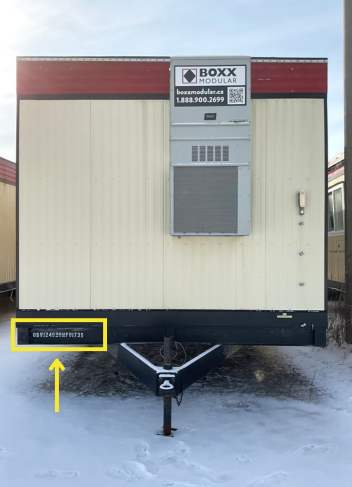
Most of our buildings have serial numbers located on the front and back. Please reference the image below:
Have a Maintenance Concern?

Your Local Branches

back to top